
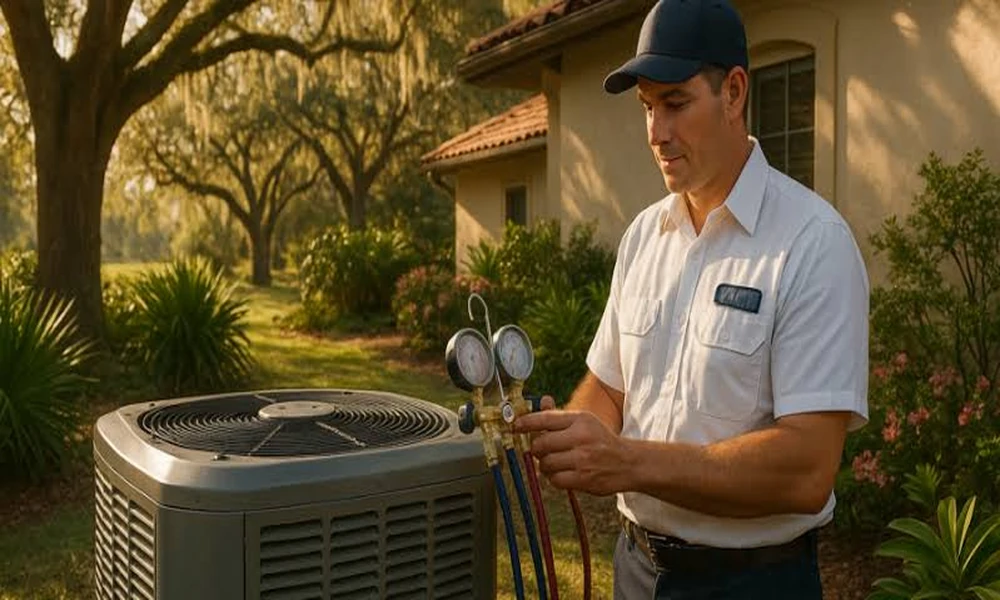
An air conditioner that fails twice in one summer rarely has bad luck. Usually it has an unsolved problem. The first visit got the house cool again, everyone was relieved, and nobody asked why the part gave out in the first place. Three weeks later the same thing happens, often on a Saturday.
Every service call in a Florida summer ends up in one of two places. One kind of repair makes the symptom go away. The other kind finds out what caused it. Both can cost about the same on the day. The difference shows up a month or a year later.
Homeowners searching for Winter Heaven hvac repair after a repeat breakdown are often told the same thing by Lee Rankin and his crew, a family-run outfit working out of 320 3rd St SW. The fix that lasts comes from finding the cause behind the failed part. Their NATE certified technicians take emergency calls around the clock and work on all makes and models. Many of their Google reviews come from people who called them for a second opinion after another company kept treating the same symptom.
Six Repairs and Their Two Versions
Most of the AC calls in Polk County fall into a short list of complaints. Each has a fast version and a thorough version.
| What the homeowner notices | The quick fix | What the real fix checks |
|---|---|---|
| Outdoor unit hums but won’t start | Swap the capacitor | Motor amp draw, capacitor rating, surge damage, voltage at the unit |
| Air blows but isn’t cold | Add refrigerant | Where the refrigerant went and whether the leak can be repaired |
| Water in the closet or a tripped float switch | Flush the drain line | Line slope, trap, venting, algae buildup, secondary pan |
| Ice on the indoor coil or copper lines | Thaw it and restart | Filter, blower speed, closed returns, dirty coil, low charge |
| Breaker keeps tripping | Reset it | Compressor draw, pitted contactor, loose wiring, insects in the panel |
| System turns on and off every few minutes | Replace the thermostat | Equipment sizing, thermostat placement, refrigerant charge |
The quick fix is not always wrong. Sometimes a capacitor is simply old and worn out. The trouble starts when the repair stops at the part and nobody asks why it failed.
Why Capacitors Keep Dying in Polk County Backyards
The run capacitor is the most commonly replaced part on a Florida condenser, and the climate explains much of it. A metal cabinet in full sun bakes the capacitor all afternoon. Heat breaks it down over time. Central Florida also sees more lightning strikes than almost anywhere else in the country, and power surges damage capacitors too.
A second failure in one season is a different story. It can mean the fan motor is drawing too much current and wearing the new capacitor out. It can also mean the replacement had the wrong microfarad rating, or that the voltage at the house sags under load. A technician who reads amperage on the motors before leaving finds those problems on the first visit, not the third.
Topping Off Refrigerant Versus Finding the Leak
An air conditioner does not use up refrigerant the way a car uses gas. The system is sealed, so a low charge means it leaked somewhere. Adding more without searching for the leak is like pumping up a tire with a nail still in it. The cooling comes back for a while, and the bill comes back too.
ENERGY STAR’s maintenance checklist points out that having too much or too little refrigerant both hurt efficiency and shorten the life of the equipment. Indoor evaporator coils in humid Florida homes can develop pinhole leaks from corrosion. Brazed joints and valve cores on the outdoor unit are other common spots. A real repair uses an electronic detector, bubble solution or a nitrogen pressure test to find the leak.
Type of refrigerant changes the math. Older systems still running R-22 depend on a refrigerant that is no longer produced, so each recharge gets expensive. Newer equipment is moving to lower-impact refrigerants such as R-454B and R-32. For an aging R-22 system, finding a leak often prompts a talk about replacing the unit rather than another recharge.
Water Where Water Shouldn’t Be
In a Florida summer, an air conditioner pulls gallons of water out of the air every day. That water runs out through a PVC drain line, and algae grows inside it. Flushing the line with a wet vac clears the clog. But if the line has poor slope, no vent or a trap with sludge in it, the clog will come back.
A thorough visit checks the run of the line from end to end. It also tests the float switch and checks the secondary pan for rust. That matters most in an air handler in the attic, where a hidden overflow can quietly damage a ceiling.
Frozen Coils and Tripped Breakers
Ice on the indoor coil looks dramatic, but it is a symptom. Restricted airflow is usually behind it, from a clogged filter, a weak blower, a crushed return duct or furniture blocking returns. Low refrigerant is the other common cause. Letting the coil thaw and walking away guarantees it will freeze again.
Breakers trip for a reason too. Florida adds one odd cause. Fire ants are drawn to the electrical field in outdoor contactors and pack themselves between the contacts. A technician who finds a pitted contactor or ants in the panel has found the real fix. A technician who only flips the breaker back on has not.
Signs You Got the Thorough Version
The paperwork often tells you which kind of repair you got. A visit that went after the cause usually leaves you with these.
- Readings on the invoice, such as refrigerant pressures, motor amp draw or the temperature drop across the coil
- An explanation of why the part failed, not just which part was replaced
- A note about anything else that is borderline, so it doesn’t become a surprise later
- Options with prices attached when repair and replacement are both reasonable
A good technician can also show you the burned contactor, the bulging capacitor or the algae plug in the drain line.
In a climate where the AC runs almost all year, the gap between a quick fix and a lasting repair adds up fast.

Comments are closed.